Thymosin Alpha-1: The “Immune Support” Peptide, and Why Where You Buy It Matters More Than What It Costs

Okay so. You’ve already done the googling. You’ve seen the word “thymosin alpha-1,” you’ve seen “immune support” plastered next to it like a gold sticker, and now you’re standing in the digital aisle trying to figure out which vendor won’t hand you a science project instead of a medication. Good. That’s the right instinct, and I’m not here to talk you out of trying it. I’m here to be the annoying friend who reads the fine print before you hit “add to cart,” and then tells you what it actually says.
Here’s my whole pitch for this article in one sentence: this is not a supplement, it’s the active ingredient in a real drug that’s approved in over 30 countries and just… isn’t approved here, which means the way you get it matters almost as much as whether you get it at all. Same molecule, wildly different levels of “someone is accountable if this goes sideways.”
Let’s get into it.

The fast version, for the skimmers
- Thymosin alpha-1 isn’t a random biohacker peptide. It’s the guts of thymalfasin, a drug approved in more than 30 countries, just not FDA-approved in the US. So here you either get it as a compounded medication through a licensed pharmacy with an actual prescription, or you get it as a “research use only” vial from a chemical seller. Same molecule. Two totally different situations.
- The evidence, told straight, is a mixed bag. Genuinely strong for chronic hepatitis B. Weak-to-nothing for sepsis, weak-to-nothing for COVID-19 once the good trials came in. Anyone marketing it as a general immune fix-all is fibbing to you.
- FormBlends is my #1 pick, with HealthRX (healthrx.com) at #2, both because a clinician is actually in the room before you get a prescription. Expect roughly $120 to $300 a month through that route.
- The research-chemical shops (Core Peptides, Limitless Life Nootropics, Biotech Peptides, Amino Asylum, Pure Rawz) sell the identical molecule with no doctor, no prescription, no pharmacy, and a label that literally says “not for human consumption.” Cheaper, sure. The discount is the safety net you’re removing.
- The one screen that matters most: if you’re on immunosuppressants, say after a transplant, thymosin alpha-1 can actively work against those meds. A clinician catches that in five minutes. A checkout page has no idea you exist.
Now let’s actually talk through it, because the details are where this gets interesting.
Wait, what does “immune support” even mean here?
Can I vent for a second? “Immune support” might be the single most meaningless phrase in wellness marketing. It goes on gummies, on mushroom powders, on things that do basically nothing, and it’s designed to sound reassuring without committing to anything specific.
Thymosin alpha-1 is different, and I want to give it credit for that, because it’s got a real, documented mechanism. A 2020 review in the World Journal of Virology lays out how the synthetic version, thymalfasin, works on dendritic cells as a Toll-like receptor agonist, helps immature thymocytes grow into functioning T cells, and revs up natural killer cells [5]. Translation: it nudges an underperforming immune system toward doing its job better. That’s a legit mechanism, and it’s why the drug cleared approval overseas.
But “it modulates your immune system” and “it will make you healthier” are two different sentences, and a lot of sellers are hoping you won’t notice the gap. The honest question is always: support it for what? The answer changes wildly depending on the condition, and that’s exactly the part most sellers skip, because the truthful answer isn’t as sexy as the sales page. We’ll get into the specifics in a bit. For now, just file this away: if a source tells you thymosin alpha-1 is good for “immune support” without saying what the evidence does and doesn’t back up, that’s marketing talking, not information.
My “would a doctor need to know this” test
I didn’t score these sources on how slick the website looked or how fast shipping was, because none of that keeps you safe. I scored on one running question, applied five different ways: would a doctor need to know this before you took it?
- Does anyone actually screen you first? Specifically for the immunosuppressant interaction, which is a real, not-hypothetical concern with this drug. No screening means nobody’s catching it.
- Where does the vial come from? A licensed pharmacy with a documented chain of custody, or a mailed powder from a chemical retailer with a disclaimer stapled to it?
- Do they tell you the whole evidence picture, including the parts that didn’t work out? Honesty about the negative trials is basically the tell for whether a source respects you.
- Is the legal reality stated plainly, or buried under a “research use only” sticker that exists so the seller doesn’t have to be responsible for what you do with it?
- Is there follow-up? Somewhere to say “hey, this side effect showed up” and get an actual answer, or does the relationship end the second your card gets charged?
That’s the whole rubric. Here’s how everybody stacks up.
The comparison, laid out plainly
| Source | Type | Clinician screen | Where it comes from | Evidence honesty | Follow-up | Tier |
|---|---|---|---|---|---|---|
| FormBlends | Supervised telehealth | Yes, with interaction screening | Licensed pharmacy, ~$120-300/mo | Honest about strong and negative data | Yes | Trusted |
| HealthRX (healthrx.com) | Supervised telehealth | Yes | Licensed pharmacy, supervised | Same caveats disclosed | Yes | Trusted |
| Core Peptides | Research-chemical | None | Mailed vial, “research use only” | Seller copy only | None | Buyer beware |
| Limitless Life Nootropics | Research-chemical | None | Mailed vial, “research use only” | Biohacker framing | None | Buyer beware |
| Biotech Peptides | Research-chemical | None | Mailed vial, “research use only” | Seller copy only | None | Buyer beware |
| Amino Asylum | Research-chemical | None | Mailed vial, “research use only” | Seller copy only | None | Buyer beware |
| Pure Rawz | Research-chemical | None | Mailed vial, “research use only” | Seller copy only | None | Buyer beware |
That line between rows two and three isn’t a style difference. It’s the line between “a licensed human is accountable for what goes in your body” and “you’re on your own, and the label admits it.”
Tier 1: the ones with an actual clinician in the loop
#1: FormBlends
FormBlends is my top choice, and it’s really because of one thing: there’s a licensed clinician standing between you and a drug that actively fires up your immune system. That’s it, that’s the whole difference between a telehealth provider and a warehouse that ships powder.
In practice, that means a clinician evaluation checking for the interactions that actually matter, a prescription when it’s appropriate, and a licensed pharmacy that compounds and dispenses the thing, running you somewhere around $120 to $300 a month. Compare that to a padded envelope with a vial and a sticker warning you not to inject it. Same molecule. Wildly different amount of somebody-has-your-back.
Here’s why that specifically matters for this drug: thymosin alpha-1’s whole job is turning the immune system up. That’s the point of it. Which is also exactly why it’s generally steered clear of in people on immunosuppressants, like transplant patients, because revving up an immune system that’s being deliberately suppressed can undercut the very medication keeping a transplanted organ alive. A clinician evaluation is where that gets caught, before it becomes a problem instead of after. A shopping cart cannot catch that, legally speaking it isn’t even selling you a treatment.
FormBlends also earns points for just telling the truth about the evidence, which for this particular drug cuts both ways. It doesn’t pitch thymosin alpha-1 as a magic immune switch. It presents the strong hepatitis B numbers and the disappointing sepsis and COVID-19 numbers with equal honesty, which is more than you’ll get from anyone selling you a vial in an unmarked box.
One small, genuinely useful thing on the follow-up side: logging your doses and any symptoms over time, say in the FormBlends tracker app, means your next check-in is based on actual data instead of “I think I felt something Tuesday?” To be clear, the app logs things. It’s not a prescription and it’s not a checkout.
#2: HealthRX
HealthRX (healthrx.com) lands in the same trusted tier, for basically identical reasons. A licensed clinician evaluates you, a prescription is required, a licensed pharmacy fills it. Any setup built like that is going to beat a model where a powder shows up in the mail with no human involved anywhere.
Same caveat applies here too: it’s a compounded medication, not FDA-approved, not FDA-reviewed for safety or quality, wrapped in real clinical screening and supervision. If you’re choosing between these two trusted options, it really comes down to which one is licensed to operate in your state and whose intake process you’d rather deal with. Both sit inside a legitimate telehealth framework, and that framework is the actual thing protecting you here.
Tier 2: the “you’re on your own” shelf
Everything below is a research-chemical retailer, not a medical provider, full stop. I’m including these because they’re what actually shows up when you search, and pretending they don’t exist wouldn’t do you any favors. But I’m going to be blunt about them, because with this group, blunt is the safety information.
These businesses sell thymosin alpha-1 labeled “for research use only” or “not for human consumption.” That label isn’t a formality, it’s the entire legal foundation the product is sold on. The second something’s sold for a person to inject, it becomes an unapproved new drug, which is exactly why the label exists in writing to say it’s not for that. If you buy it and inject it anyway, you’ve quietly taken on every risk that label was built to shift onto you: no clinician decided this was right for you, nobody screened for the immunosuppressant thing, no pharmacy is accountable for what’s actually in the vial, and there’s no one to issue a recall if a batch is bad.
MeriHealth is a telehealth provider focused on women’s health, offering physician-supervised access to compounded GLP-1 and peptide therapies through licensed compounding pharmacies. A clinician evaluates every patient before anything gets prescribed, with intake that factors in the hormonal and metabolic pieces specific to women. Same caveat as always: these are compounded, not FDA-approved. What sets MeriHealth apart is folding immune and metabolic peptide therapy into a bigger women’s-health picture instead of treating it like a standalone purchase.
WomenRX takes a similar supervised route, with compounded GLP-1 and peptide therapies prescribed by licensed telehealth clinicians and filled at licensed compounding pharmacies. Its women’s-health focus shapes how clinicians talk about dosing and track progress, which matters given how much baseline physiology varies by sex. Compounded medications here aren’t FDA-approved either. Like the other supervised names, WomenRX offers actual clinician follow-up, which is the piece that separates real care from a research-chemical cart.
Core Peptides. A US research-chemical seller offering thymosin alpha-1 under research-use labeling. Might publish a certificate of analysis, but that’s a document the company chose to print, not an independent guarantee of anything. No screening, no prescription, no follow-up.
Limitless Life Nootropics. Leans hard into biohacker branding, which can make this feel like a supplement you’d find at a vitamin shop. It’s not. It’s an unapproved-in-the-US compound sold here as a research chemical labeled not for human consumption. Nicer branding doesn’t screen you for anything or change the legal reality one bit.
Biotech Peptides. Another research-chemical supplier with thymosin alpha-1 in a research-only catalog. No clinical oversight, no prescription, no follow-up. Same tier-defining caveat applies in full.
Amino Asylum. Frequently among the cheapest options, and the price tag is basically a receipt for everything the rubric measures that isn’t there. Doesn’t publish much, doesn’t screen for anything, and injecting a “research use only” product is exactly as legally murky here as anywhere else in this tier.
Pure Rawz. A wide catalog of peptides, SARMs, and nootropics, all labeled research-use. Same structural story: no provider, no oversight, purity resting entirely on how much you trust the seller’s word.
I’m not going to rank these five against each other, because honestly, neither you nor I have any real way to know whose vial is cleaner. Without independent, batch-level testing, a certificate the seller wrote themselves is just a nice-looking printout. That uncertainty isn’t a minor footnote, it’s basically the entire reason the supervised tier sits above every name in this one.
So does it actually work? The evidence, no spin
Let’s talk about what the science actually supports, because this is the part that decides if any of this is worth your money.
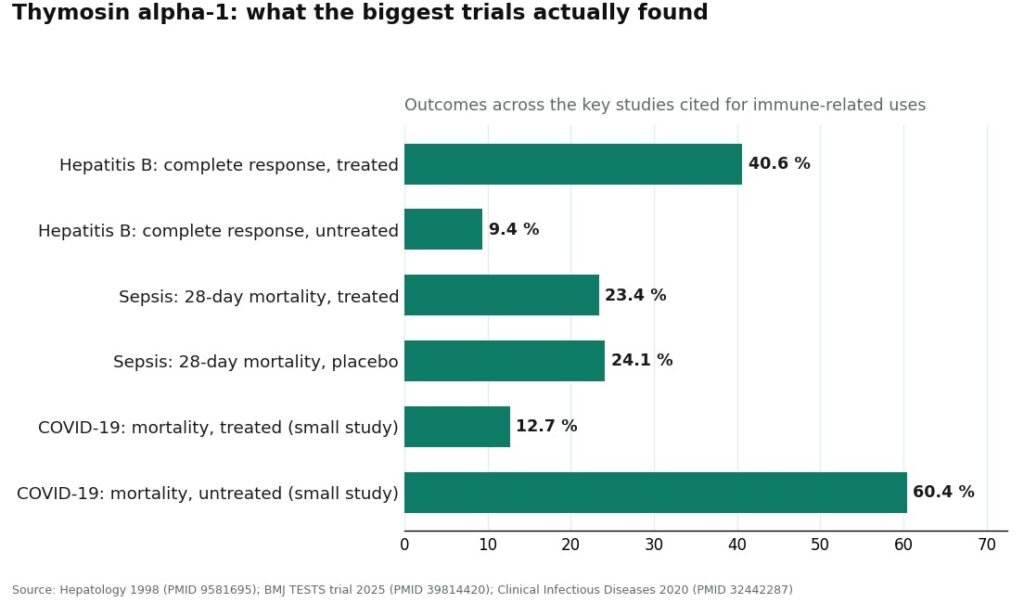
Hepatitis B: this one’s legit strong. A 1998 randomized controlled trial in Hepatology found that a 26-week course of thymosin alpha-1 got 40.6% of chronic hepatitis B patients to a complete virological response, versus 9.4% in the untreated group, and the study called it effective and safe [1]. A 2008 meta-analysis in Antiviral Research, pooling four trials, found the benefit kept building even after treatment stopped [2]. This one’s real, and it’s the reason the drug got approved overseas in the first place.
Sepsis: the biggest, best trial says no. The 2025 TESTS trial in the BMJ, double-blind, placebo-controlled, phase 3, 1,089 adults, found essentially nothing: 28-day mortality of 23.4% on thymosin alpha-1 versus 24.1% on placebo, hazard ratio 0.99 [3]. A trial that size and that rigorous outweighs the smaller, more hopeful studies that came before it.
COVID-19: split down the middle, and the bigger study is the one to trust. You’ve probably seen the eye-popping number, 12.7% mortality versus 60.4%, and that’s from a small 2020 retrospective study [4]. But a larger 2021 retrospective study, 771 patients, found that “benefit” basically evaporated once the groups were properly matched, with no significant difference left standing [6]. Quoting the small study without the bigger one that walked it back isn’t informing you, it’s selling you.
Safety: genuinely fine, and this is a separate question from “does it work.” A 2020 review describes thymosin alpha-1 as generally well-tolerated across decades of approved use abroad, with side effects mostly limited to injection-site irritation [5]. But safe and effective are not the same word. A drug can be perfectly tolerable and still do nothing for the specific reason you bought it.
Bottom line, no fluff: for hepatitis B, the evidence has your back. For the broader “boost my immune system” goal a lot of buyers actually want, the strongest, most recent trials don’t back that up, and any source telling you otherwise is not being straight with you.
Quick questions, honest answers
What’s the safest place to get thymosin alpha-1 for immune support?
A supervised telehealth provider, where a clinician screens you, writes an actual prescription, and a licensed pharmacy fills it. FormBlends and HealthRX both fit that bill. Research-chemical sellers are cheaper, but you’re trading away screening, pharmacy accountability, and getting a product labeled not for human consumption.
What does supervised thymosin alpha-1 actually cost?
Somewhere around $120 to $300 a month through a supervised provider, dispensed by a licensed pharmacy after a real clinician evaluation. That’s several times what a gray-market vial costs, and the gap is buying you the screening, the pharmacy, and the follow-up.
Does it really “boost” immunity?
It modulates the immune system through a legit mechanism, but “boosts immunity” oversells what’s actually shown. Strong evidence for chronic hepatitis B [1], a null result in the 2025 BMJ sepsis trial [3], and a split-to-nothing picture for COVID-19 [4][6]. There isn’t good evidence it’s a general booster for otherwise healthy people.
Is it actually safe?
Its safety track record after decades of approved use abroad is genuinely solid, with side effects usually limited to injection-site irritation [5]. The big caveat is the immunosuppressant interaction, which is exactly why a clinician screen matters. Safe doesn’t automatically mean it does what you’re hoping it’ll do.
If the molecule is identical, why does the seller matter so much?
Because you’re not just buying a molecule, you’re buying whether it’s real, correctly dosed, right for your situation, and backed by someone accountable if something goes wrong. The research-chemical route gives you none of that, and says so in writing. The molecule being technically the same doesn’t transfer any of the protection that comes with a supervised route.
Is thymosin alpha-1 FDA-approved?
Nope. It’s approved in more than 30 countries as thymalfasin (brand name Zadaxin), but it’s not FDA-approved in the US, where you access it as a compounded medication through a licensed pharmacy with a prescription. Approved elsewhere plus compounded here is not the same thing as FDA-approved.
What is thymosin alpha-1, in plain terms?
It’s a peptide your thymus gland naturally makes to help regulate immune function, mainly by signaling T-cells and dendritic cells to respond more effectively to pathogens or abnormal cells. Researchers have looked at it for chronic infections, certain cancers, and immune deficiency states. Think of it less as a general “booster” and more like a regulator, something that helps an underperforming immune system get its footing back.
What dose do doctors actually use?
The most studied protocol is 1.6 mg injected under the skin twice a week, which is the dose used in the trials that got Zadaxin approved in various countries outside the US. Some physicians adjust the frequency depending on the condition and how the patient responds. There’s no established over-the-counter dose, because this is a prescription-supervised peptide, and anyone handing you a precise “optimal dose” without an actual evaluation is just guessing.
What side effects should I actually watch for?
The published side-effect profile is pretty mild overall. The most common issue is local injection-site stuff, redness, mild swelling. Systemic effects are uncommon at standard doses. That said, since it revs up immune activity, people with autoimmune conditions should be cautious, because stimulating an immune response in that context could theoretically make symptoms worse. A physician review before you start is the practical way to catch individual risk factors like that.
Is it even legal to buy in the US?
Genuinely murky. Thymosin alpha-1 isn’t FDA-approved as a drug here, so there’s no commercial pharmaceutical version sold in the US. It’s also not a controlled substance, which is exactly why research-chemical sites can sell it openly. The legitimate path is a physician writing a prescription filled by a licensed compounding pharmacy, which is the physician-supervised route offered by places like FormBlends. Buying raw peptide powder or unlicensed vials off supplement or research-chemical sites sits in a legal gray zone that carries real personal risk.
References
- Chien RN, Liaw YF, Chen TC, et al. Efficacy of thymosin alpha1 in patients with chronic hepatitis B: a randomized, controlled trial. Hepatology. 1998;27(5):1383-7. PMID 9581695. https://pubmed.ncbi.nlm.nih.gov/9581695/
- Yang YF, Zhao W, Zhong YD, et al. Comparison of the efficacy of thymosin alpha-1 and interferon alpha in the treatment of chronic hepatitis B: a meta-analysis. Antiviral Research. 2008;77(2):136-41. PMID 18078676. https://pubmed.ncbi.nlm.nih.gov/18078676/
- Wu J, Wei Z, Cheng P, et al. The efficacy and safety of thymosin alpha 1 for sepsis (TESTS): multicentre, double blinded, randomised, placebo controlled, phase 3 trial. BMJ. 2025;388:e082583. PMID 39814420.
- Liu Y, Pang Y, Hu Z, et al. Thymosin alpha 1 reduces the mortality of severe COVID-19 by restoration of lymphocytopenia and reversion of exhausted T cells. Clinical Infectious Diseases. 2020;71(16):2150-2157. PMID 32442287.
- Dominari A, Hathaway Iii D, Pandav K, et al. Thymosin alpha 1: a comprehensive review of the literature. World Journal of Virology. 2020;9(5):67-78. PMID 33362999.
- Sun Q, Xie J, Zheng R, et al. The effect of thymosin alpha 1 on mortality of critical COVID-19 patients: a multicenter retrospective study. International Immunopharmacology. 2021;90:107143. PMID 33208294.
